Satellite Images Reveal Pakistani Navy’s Strategic Retreat to Iran Border During ‘Operation Sindoor’
New evidence, cited in an India Today report, contradicts Islamabad's claims of a 'strong reply' to Indian military action, suggesting a defensive repositioning of key naval assets to avoid precision strikes.

Key Takeaways
-
New Intelligence: High-resolution satellite imagery has reportedly captured the Pakistan Navy moving its warships away from primary naval bases during India’s ‘Operation Sindoor’.
-
Strategic Retreat: Key naval assets were repositioned, with some moved to Karachi’s commercial docks and others shifted further west, near the maritime border with Iran.
-
Contradictory Evidence: This defensive maneuver challenges Pakistan’s earlier claims of having delivered a “strong reply” to India, suggesting the primary focus was on asset preservation.
-
Timing is Crucial: The naval redeployment was observed between May 7 and May 10, coinciding directly with the period of India’s precision anti-terror strikes.
-
Operation Sindoor Context: The Indian operation was a retaliatory action for the Pahalgam attack, involving joint Army-Air Force strikes on nine terror camps in Pakistan and Pakistan-occupied Kashmir on the night of May 7-8.
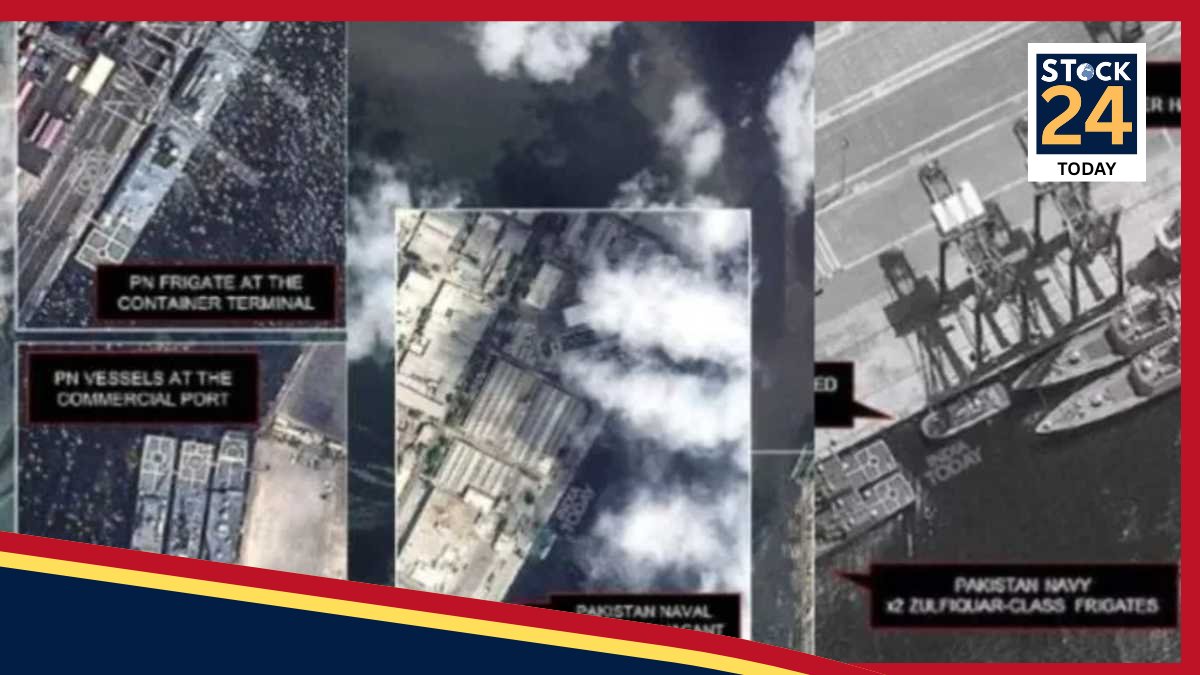
NEW DELHI – In a significant development following India’s ‘Operation Sindoor’, new satellite images have emerged that appear to show the Pakistan Navy conducting a large-scale strategic retreat of its naval assets, moving warships to safer locations, including near the Iranian border.
According to a report by India Today, which released the satellite imagery, the evidence provides a compelling visual account of Pakistan’s defensive posture in the wake of Indian military action. The report asserts that the images are strong proof that Pakistan was forced to redeploy its navy to protect its fleet from potential further strikes.
The analysis of the imagery indicates that numerous Pakistani warships were moved from their main operational naval bases. On May 8, just one day after India’s initial strikes, key vessels were notably absent from their regular berths. The images allegedly show three of these warships relocated to the relative cover of Karachi’s bustling commercial port, while at least one other was moved to an undisclosed location.
Crucially, the satellite pictures also reveal a westward shift of naval assets towards the Iran border, a move interpreted as an attempt to create maximum distance from the range of Indian military capabilities. This redeployment happened concurrently with Indian precision strikes carried out between May 7 and May 10.
Challenging the Narrative
This new visual evidence stands in stark contrast to Pakistan’s official narrative, which had previously claimed its forces mounted a “strong reply” to the Indian operation. The reported repositioning of its most valuable naval assets suggests that the Pakistan military’s primary concern was defensive—safeguarding its fleet rather than engaging in a direct counter-offensive. The movement is being widely interpreted as a tacit acknowledgment of the threat posed by the Indian military’s operational reach and precision.
Background: The Swift and Precise ‘Operation Sindoor’
‘Operation Sindoor’ was launched by the Indian armed forces during the night of May 7 and May 8. The operation was a direct response to the deadly terrorist attack in Pahalgam, which resulted in the deaths of 26 people.
In a coordinated joint effort, the Indian Army and the Indian Air Force executed a series of lightning strikes between 1:05 am and 1:30 am, targeting nine terror-related sites within Pakistan and Pakistan-occupied Kashmir. The surprise attack involved the firing of 24 precision missiles at key terrorist infrastructure, including facilities in Muridke and Bahawalpur—known strongholds of Lashkar-e-Taiba (LeT) and Jaish-e-Mohammed (JeM), respectively.
Following the operation, the Indian government officially stated that the strikes were carefully calibrated to be “limited” and “non-escalatory.” Officials stressed that the targets were specifically terrorist launchpads and training camps, with a conscious effort made to avoid Pakistani military installations. The stated objective was not to provoke a wider conflict but to dismantle the terror networks responsible for the Pahalgam attack. The latest satellite imagery adds a critical new dimension to the strategic aftermath of this significant military action.